Orecraft: Orc Mining Camp
- 4.3
- Rating
- 1.00M
- Installs
- Free
- Price

 Analysis by App-foxy
Orecraft: Orc Mining Camp is the kind of simulation game I opened expecting a simple mining loop and ended up judging more by its mood than by its headline premise. I played it as a compact management adventure: gather ore, turn materials into useful items, expand an orc settlement, and decide which improvements deserve attention first. The presentation gives those actions a clear fantasy identity, so the work feels connected to the setting rather than like a collection of unrelated menus.
That distinction matters because this is not trying to be a realistic mine-management tool. It is a light, approachable game about building an orc empire through resource gathering and crafting. The free entry point makes it easy to test, while optional purchases ranging from $1.99 to $99.99 per item mean I would approach progression with a little discipline. I enjoyed it most when I treated each session as a short planning exercise instead of trying to rush every upgrade.
Developed by Evrika Games LLC, the game sits in the simulation category but borrows the forward motion of a fantasy adventure. It has reached over a million installs and holds an average rating of 4.3 from around 43 thousand ratings, which fits my impression of a game designed to be immediately understandable. It is rated Everyone, runs on Android 8.0 or later, and the current version is 1.10.10. Those details make it a reasonable candidate for a broad audience, although the best experience still depends on whether you enjoy repeated gathering and incremental construction.
You May Also Like

 Blood Strike: 2.5 Anniversary
Blood Strike’s Loadouts Turn Every Drop Into a Tactical Gamble
A close look at Blood Strike’s custom loadouts: how fast access to signature weapons reshapes its battle royale rhythm, rewards preparation, and narrows the gap between fights.

 Pandora - Music & Podcasts
Pandora’s Music Is Easy to Start, but Harder to Recover
Pandora’s strength is its low-effort path from a seed to a station. Its weak spot is how much confidence it asks you to place in connection, setup, and quiet recovery.

 8 Ball Pool
 Is Built on Rivalries, Rematches, and Routine
A close look at the rivalries, rematches, shared routines, and unanswered safety questions that turn a quick pool match into a persistent mobile community.

 Samsung Music
’s Quiet Strength Is Playing What You Already Own
Its reach comes less from spectacle than from dependable access to a personal library. That simplicity is both the app’s strongest retention engine and its ceiling.

 AccuWeather: Weather Radar
AccuWeather Review: A Quick, Clear Forecast for Everyday Decisions
For everyday plans, the best forecast is the one you can understand quickly. AccuWeather makes rain timing, radar, and local conditions easy to act on, with a few trade-offs.

 Hill Climb Racing
Why Hill Climb Racing Still Turns Crashes Into One More Run
A tiny car, a bumpy hill and one more upgrade: Hill Climb Racing keeps resurfacing because its simple chaos makes every near-miss feel personal.
More From Our News Desk



From a simple mine to a readable orc settlement
I found that the camp becomes easier to manage when I treat it as more than a place to collect ore: it gives each crafting choice a visible purpose and makes small improvements easier to track. In this section, I look at how the settlement’s presentation supports that sense of progress, before turning to the patience the game asks of its players.
The first impression is clear, but the long-term appeal depends on your patience
My first positive reaction was how quickly the game communicates its basic purpose. I did not need a long explanation to understand that ore is the foundation, crafting turns raw materials into progress, and construction gives that progress a visible home. The orc theme helps each step feel more memorable than a neutral collection of resource bars. Even when the underlying action is familiar, the setting gives it personality.
The opening rhythm is comfortable for players who like gradual development. I could make a small improvement, gather again, and return with a better idea of what the settlement needed next. That loop is satisfying because it creates a clear relationship between effort and change. At the same time, the early simplicity can feel modest if you are looking for a deep strategy simulator with many competing systems from the beginning.
I would describe the pacing as deliberately steady. It gives you room to understand the value of materials instead of throwing every possible task at you at once. The trade-off is that players who prefer constant surprises may find the first sessions restrained. For me, the slower start worked because it let the visual identity and crafting theme settle in before the game asked me to think about efficiency.
One useful habit is to avoid spending every newly collected resource immediately. I found it more rewarding to keep a small reserve and think about the next meaningful improvement rather than treating each available action as mandatory. This is especially helpful when a session is short: I could gather, make one sensible decision, and leave without feeling that I had damaged my settlement by stopping early.
The art direction makes ordinary resource work feel purposeful
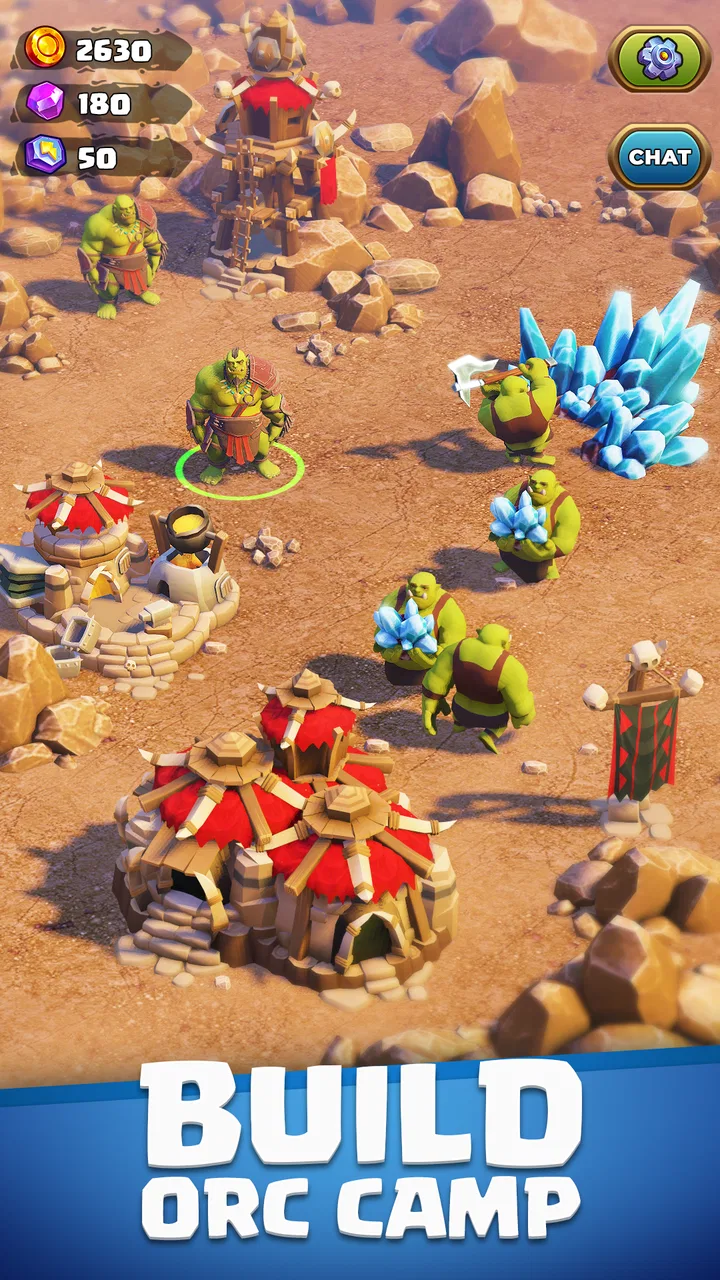
The visual language is built around a rough, colorful fantasy settlement rather than a realistic industrial operation. That choice supports the game’s approachable tone. Mining, crafting, and construction read as parts of one world, with the orc camp acting as the visual anchor. I never felt that the interface and the setting were fighting each other; the presentation keeps pointing back to the idea of a community growing around its mine.
What I appreciate most is the way the art gives progression a sense of place. In many resource games, an upgrade can feel like a number changing behind a menu. Here, the camp and its fantasy framing make development easier to imagine. The result is not necessarily visual complexity for its own sake. Instead, the artwork performs a practical job: it helps me remember what I am building and why the next material matters.
This also makes the game more suitable for casual play than a dense spreadsheet-style simulator. I can return after a break and quickly recover the basic situation because the settlement’s visual identity is more memorable than a long list of abstract production values. Players who want intricate realism, detailed architecture, or a serious economic model may find the presentation too playful, but that is clearly part of its appeal rather than a flaw in execution.
A less obvious strength is that the theme softens the repetition. Resource gathering is naturally cyclical, yet the orc setting gives the cycle a narrative flavor: the mine supports the camp, the camp gives purpose to crafting, and crafting feeds the next stage of growth. I still noticed the repetition when I played for a long stretch, but the setting made it easier to accept during shorter visits.
Sound and rhythm keep the work from becoming completely mechanical
The sound design contributes to the feeling that the camp is an active place rather than a silent inventory screen. Mining and crafting are actions with a physical identity, and the audio presentation helps separate one phase of the loop from another. I found that useful because the game’s rhythm is based on repeated tasks; even small sensory cues can make those tasks feel more deliberate.
I would not recommend judging the game as a sound-driven experience. Its audio supports the setting instead of dominating it. The main mood comes from the combination of fantasy visuals, short activity cycles, and the gradual movement from raw ore to a more developed camp. That restraint suits the game. It leaves enough space for a relaxed session, especially when I am playing while taking a break rather than looking for an intense action game.
The pacing and sound work together in an understated way. A quick interaction gives me a sense of completion, while the next available task prevents the session from feeling entirely passive. This is where the game’s simulation identity becomes more enjoyable: I am not only tapping through a checklist, but also settling into a repeating work rhythm. The rhythm is calming when I accept it and monotonous when I expect constant escalation.
For an everyday example, I could play during a short wait or between other tasks, collect what was available, finish a crafting decision, and stop at a natural point. I did not need to commit to a long uninterrupted campaign to feel progress. That makes the game a better fit for casual routines than for someone who wants every session to deliver a dramatic event or a large strategic reversal.
Mining, crafting, and building fit together better when you plan around bottlenecks
The central mechanical strength is the connection between gathering and construction. Ore is not just a collectible object; it is part of a chain that leads to crafted goods and settlement development. I found the most satisfying decisions came from identifying what was slowing me down. If a project required a particular material, gathering randomly was less useful than focusing on the resource that would unlock the next practical step.
This is one of the game’s more important lessons, and it is easy to miss if you play by tapping whatever is immediately available. I recommend checking the next useful improvement before committing materials. That simple habit reduces wasted effort and gives the mine a clearer purpose. It also makes the game feel more like a simulation, because progress depends on managing priorities rather than merely collecting everything in sight.
Another trade-off is the relationship between convenience and patience. Free-to-play progression can be comfortable when I let the loop run at its intended pace, but the temptation to speed things up is always part of this kind of design. Because individual in-app purchases can reach $99.99, I would not begin with an assumption that every shortcut is good value. I would first learn which upgrades genuinely change my routine and which only make a familiar action happen sooner.
My preferred approach was to treat purchases as optional convenience rather than a requirement for understanding the game. I played more carefully when I had a clear objective, such as improving the camp’s next useful stage, instead of chasing every possible enhancement. This is a practical point for younger players and families as well: the Everyone rating describes the content audience, but adults should still manage purchase access on the device.
The game is strongest when I am making small, meaningful choices. It is weaker when I expect the mechanics to provide deep tactical variety at every moment. The core loop is intentionally accessible, and that accessibility means the number of decisions can feel limited compared with more elaborate city builders or economy simulations. Those alternatives may be better for players who want complex production chains, extensive customization, or a larger strategic map.
Who will enjoy it, and who should choose something else
I would recommend Orecraft: Orc Mining Camp to someone who likes fantasy-themed progression, light resource management, and visible settlement growth. It is particularly suitable for players who enjoy checking in, completing a few tasks, and gradually making a camp more developed. The orc setting adds enough character to keep the work loop from feeling completely anonymous.
I would be more cautious about recommending it to someone who dislikes repetition or wants immediate control over a large, complicated empire. The game’s appeal comes from accumulation: gather, craft, improve, and repeat. If that structure already sounds tiring, the fantasy presentation will not completely solve the problem. A more traditional strategy game would be a better choice for someone seeking combat depth, diplomacy, or large-scale tactical decisions.
It is also not my first pick for a player who wants a purely decorative building game. Construction is connected to resource planning, so the settlement is not simply a blank canvas for freeform design. The satisfaction comes from making the camp function and progress, not from arranging every element without constraints.
Compared with a typical idle mining game, this one gives the gathering loop more identity through crafting and the orc camp. Compared with a full city builder, it is lighter and easier to approach, but less demanding in strategic scope. Compared with a crafting adventure, it places more emphasis on repeated improvement than on constant exploration. That middle position is useful: it explains why the game can appeal to casual simulation fans while still feeling too limited for genre specialists.
Small decisions that improve the day-to-day experience
The first tip I would give a new player is to set a short-term material goal before collecting. Instead of mining without a plan, I would look at the next useful craft or construction step and work backward. This turns a potentially aimless loop into a focused routine and helps reveal which resources are genuinely holding back the camp.
The second is to separate “progress” from “activity.” Not every available action needs to be completed immediately. Sometimes the best move is to gather and wait until the materials support a more valuable improvement. That approach makes the game less frantic and protects the satisfaction of seeing a meaningful change rather than several minor ones.
The third is to use the game’s mood as a signal for session length. Its art and sound are well suited to short, relaxed visits, but a long uninterrupted session can expose the repetition more clearly. I enjoyed it more when I stopped after a sensible milestone. This is not a limitation to hide; it is a useful way to match the game’s pacing to real life.
A fourth consideration is purchase restraint. Since the game is free and offers optional items across a wide price range, I would play long enough to understand my own friction points before spending. If the only benefit is avoiding a brief wait, patience may be the better value. If a purchase changes how I organize the camp, that is a more meaningful question, but I would still treat it as a personal convenience rather than something necessary to enjoy the basic loop.
The atmosphere works because every layer points toward the same fantasy
What holds the experience together is coherence. The artwork presents a rough orc community, the mining and crafting actions support that community, and the sound and pacing make the routine feel like steady camp work. None of these elements tries to turn the game into something it is not. The result is a playable mood: modest, colorful, and focused on gradual improvement.
That mood also explains why the game can feel more pleasant than its individual mechanics might suggest on paper. Mining alone is familiar. Crafting alone is familiar. Building alone is familiar. The combination becomes more distinctive because the game gives those actions a shared setting and a consistent rhythm. I found myself returning less for a single spectacular feature and more for the comfort of continuing a settlement that already felt recognizable.
There are clear boundaries. The simulation is approachable rather than deeply systemic, and the repeated loop will not satisfy everyone. Players who want a demanding management challenge should look toward a more complex builder. Players who want fast action should choose an adventure or combat game instead. But for a free fantasy game that turns resource work into a readable orc-camp routine, the balance is convincing.
My strongest recommendation is to play it as a patient camp-building game, not as a race to unlock everything. That mindset brings out its art direction, its sound-supported rhythm, and the practical satisfaction of planning around materials. It also keeps the optional purchase system from becoming the center of the experience.
After spending time with Orecraft: Orc Mining Camp, I see it as a friendly simulation for players who want a light fantasy routine with enough planning to make each improvement feel earned. It is free to start, suitable for Everyone, and broadly accessible on supported Android devices. The game does not reinvent mining or settlement management, but it gives those familiar actions a consistent orc identity and a pleasant pace.
If you enjoy watching a small camp grow through repeated, sensible decisions, I think it is worth trying. If you need deep strategy, unrestricted building, or constant novelty, I would choose a different game in the category. For the right player, though, Orecraft: Orc Mining Camp succeeds by making ordinary resource work feel like part of a living fantasy settlement, and that is enough to give its simple loop a distinct character.
FAQs for Orecraft: Orc Mining Camp
01What is Orecraft: Orc Mining Camp?
Orecraft: Orc Mining Camp is a casual resource-management and idle-style game in which you build and improve an orc mining camp. You assign workers, collect valuable ore, expand production, and use earned resources to unlock upgrades. The game focuses on short sessions, automated progress, and gradually developing your camp rather than demanding fast reflexes or complex controls.
02How does the gameplay work in Orecraft: Orc Mining Camp?
The main gameplay loop revolves around mining ore, managing your camp, and reinvesting resources into improvements. As your production grows, you can generally upgrade workers, mining facilities, storage, and other parts of the camp to increase efficiency. Much of the progress can continue automatically, making the game suitable for players who enjoy incremental advancement and checking in regularly.
03Can I play Orecraft: Orc Mining Camp offline?
The game may allow some mining and management activities to continue without a constant internet connection, but offline functionality can depend on the current version and specific features. Online access may still be needed for advertisements, cloud synchronization, events, purchases, or updates. Before relying on offline play, it is best to test the game after installation and review the requirements listed on its store page.
04Is Orecraft: Orc Mining Camp free to download and play?
Orecraft: Orc Mining Camp is generally presented as a free-to-download mobile game, allowing players to begin building their mining camp without an upfront purchase. However, free games of this type may include optional in-app purchases, advertisements, or bonuses that speed up progress. You can usually play without spending money, although patience may be needed as upgrades and resource collection become slower.
05Is Orecraft: Orc Mining Camp suitable for children and casual players?
The simple controls and management-focused gameplay make Orecraft: Orc Mining Camp approachable for casual players who enjoy idle games, incremental upgrades, and light strategy. Parents should still check the current age rating, advertising content, privacy information, and in-app purchase settings before allowing children to play. The game is easy to start, but long-term progress may involve frequent reward and upgrade prompts.
Pros
- Simple mining mechanics are easy to learn and play casually.
- Progress continues at a comfortable pace without demanding constant attention.
- Orc-themed visuals give the camp a distinctive fantasy personality.
- Short play sessions make it suitable for quick breaks.
- Camp upgrades provide clear goals and a satisfying sense of growth.
Cons
- Later upgrades can require considerable time and resource grinding.
- The core gameplay may feel repetitive after extended sessions.
- Limited strategic depth may disappoint players seeking complex management.
- Some menus and upgrade details could be clearer for new players.
- Performance may vary on older phones during busier camp scenes.

Orecraft: Orc Mining Camp
Gallery